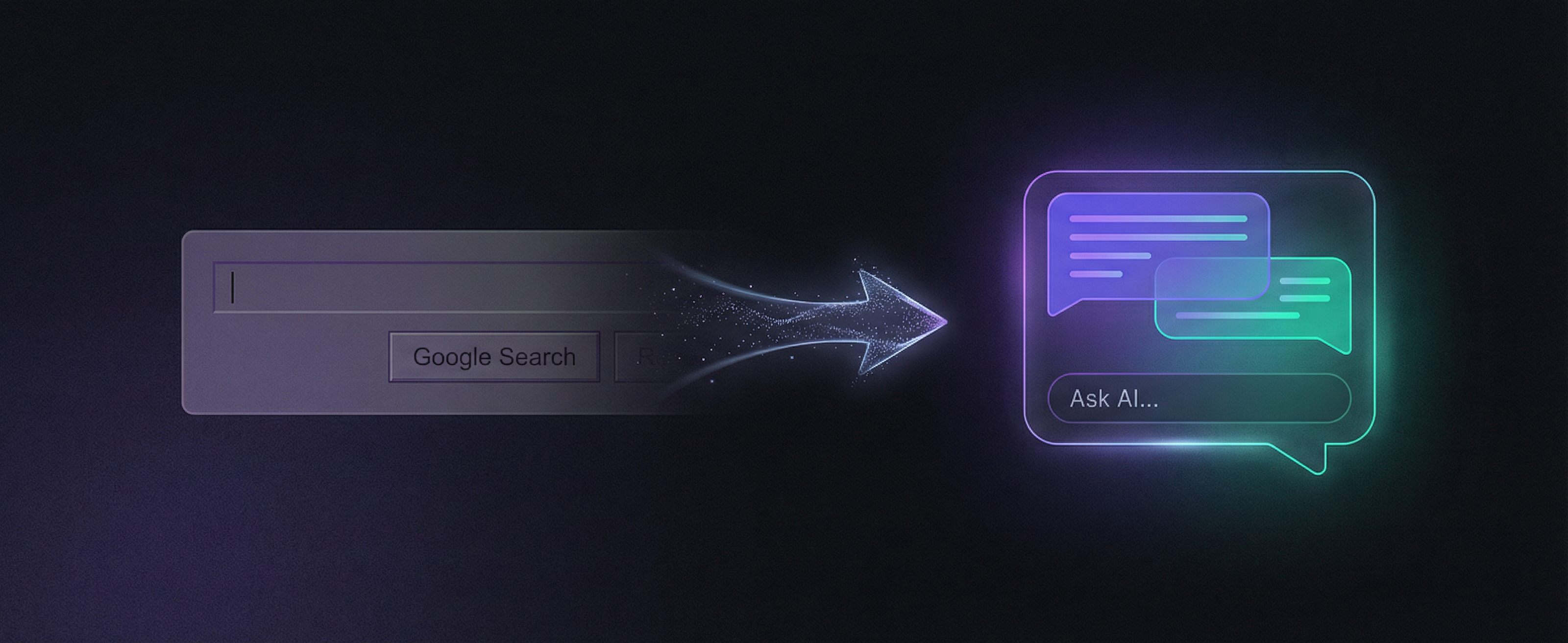
If you were on the internet in the late 2000s, you know the feeling. A coworker, a family member, or some guy in a group chat asks you a question so easily Googleable that your eye twitches. "What time does Target close?" "How many cups in a gallon?" "Is a tomato a fruit?"
Instead of answering, you'd copy their question, head to Let Me Google That For You (LMGTFY), generate a link, and send it back. The recipient would watch an animation of a mouse slowly typing their question into Google, clicking search, and landing on the results page — all while reading the subtext: "Was that so hard?"
It was peak passive-aggressive internet culture. And it was glorious.

The Rise and Fall of LMGTFY
Let Me Google That For You launched in 2008 and quickly became one of those internet staples that everyone knew about. It was simple, funny, and universally understood. The site was a cultural shorthand: sending someone an LMGTFY link was the polite-but-devastating way of saying "you could have figured this out yourself."
For over a decade, LMGTFY was the go-to response. But the internet has changed. Google is no longer the first place people go for quick answers. In fact, for a growing number of people, it's not even the second.
Google Is No Longer the Default Answer Machine
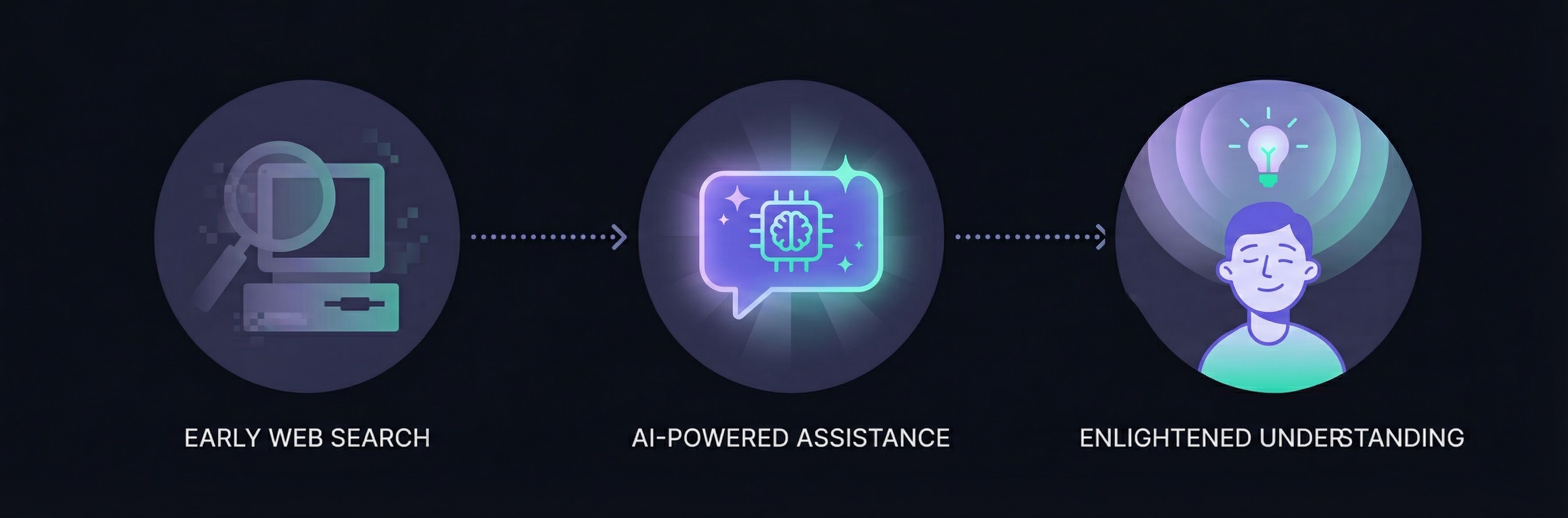
Something shifted around 2023-2024. With the explosion of ChatGPT, Claude, Gemini, and other AI assistants, the way people search for information fundamentally changed. Instead of typing keywords into Google and scrolling through ten blue links, people started asking questions in natural language and getting direct answers.
The numbers back this up. A significant portion of simple informational queries — the exact kind that LMGTFY was built for — have migrated from search engines to AI chatbots. When someone wants to know how to convert Celsius to Fahrenheit, they don't need ten results. They need one answer.
This shift created an awkward gap. The people who used to ask you things they could Google? They're now asking you things they could ask AI. The behavior hasn't changed — only the tool has.
Same Problem, New Technology
Think about the last time someone asked you a question that ChatGPT could answer in three seconds:
- "Can you explain what a VPN does?"
- "What's a good recipe for banana bread?"
- "How do I remove a background from an image?"
- "What should I write in a thank-you email?"
These aren't complex questions that need human expertise. They're the modern equivalent of "let me Google that for you" questions — except now the answer isn't on Google. It's in ChatGPT.
The problem with LMGTFY in 2026 is that sending someone to Google for these questions actually isn't the best advice anymore. Google results are cluttered with ads, SEO spam, and AI-generated summaries that may or may not be helpful. The genuinely fastest path to an answer is to just ask an AI.
Enter: Let Me Ask AI For You
LetMeAskAI.fyi is the spiritual successor to LMGTFY, built for how people actually get answers in 2026. The concept is the same: generate a link, send it to the person who asked you a lazy question, and let the animation do the talking.
Here's how it works:
- Type in the question someone should have asked AI themselves
- Generate a shareable link
- Send it to them
When they open the link, they see a realistic ChatGPT-like interface. A mouse cursor animates across the screen, types their question into the input field, and clicks send — with step-by-step instructions showing them exactly how easy it is. Then it redirects them to the actual ChatGPT with their question pre-filled, so they get their answer too.
It's not just passive-aggressive. It's educational. They learn how to use AI while getting their question answered.
Why This Matters Beyond the Joke
Here's the thing that makes this more than just a gag site: a surprising number of people still haven't tried AI assistants. Despite the hype, despite the headlines, despite ChatGPT being the fastest-growing consumer product in history — many people have never actually typed a question into an AI chatbot.
Some reasons:
- They don't know where to start. "AI" sounds intimidating. A chat interface is simple.
- They don't realize how good it is. Until you see AI answer your specific question, it's abstract.
- Habit. They've always asked a friend or Googled it. Why change?
Sending someone a LetMeAskAI link doesn't just tell them to use AI — it shows them. The animation walks them through the exact steps, and then drops them into ChatGPT with their question ready to go. Zero friction. The next time they have a question, they'll remember how easy it was.
The Art of the Passive-Aggressive Link
Let's be honest — part of the appeal of LMGTFY was the delicious passive-aggressiveness. And LetMeAskAI.fyi preserves that energy perfectly. There's something deeply satisfying about responding to "hey, what's the capital of Mongolia?" with a link that slowly, methodically shows them how to type that exact question into ChatGPT.
The beauty is in the subtext. You're not saying "why didn't you just ask AI?" You're showing them. It's the difference between telling someone they should exercise and signing them up for a gym membership.
How People Are Using It
Since launch, the most common use cases have been:
- Group chats: Someone asks a basic question, someone else drops the link. Classic.
- Work Slack channels: The modern office equivalent of the LMGTFY response.
- Teaching older relatives: "Mom, next time you have a question like this, try this" — but in link form.
- Tech support: Instead of explaining something for the hundredth time, show them how to ask AI.
The LMGTFY Legacy
Let Me Google That For You was a product of its time — a time when Google was the undisputed answer to everything, and the idea of not Googling something was borderline offensive to internet-savvy people.
We're in a new era now. AI assistants have become the fastest way to get a direct answer to a straightforward question. The etiquette hasn't caught up yet — people still ask other people things they could ask a machine — but it will. Sites like LetMeAskAI.fyi are part of that cultural shift.
Until then, the next time someone asks you something ChatGPT could answer in two seconds, you know what to do.
Frequently Asked Questions
Is LetMeAskAI.fyi free?
Yes, completely free. No sign-up required. Generate a link and share it.
Does it actually send the question to ChatGPT?
Yes. After the animation plays, the recipient is redirected to ChatGPT with their question pre-filled. They get the answer immediately.
Is this like LMGTFY but for AI?
Exactly. Same concept, updated for 2026. Instead of showing someone how to Google, it shows them how to ask AI.
Can I use it to genuinely help someone learn AI?
Absolutely. Not every use has to be passive-aggressive. It's a great way to introduce someone to AI chat interfaces — the animation walks them through the exact steps.
What languages does it support?
The interface auto-detects your browser language and supports English, Spanish, French, Portuguese, Chinese, Hindi, Arabic, and Ukrainian.